


Tropical Africa - Life World Library
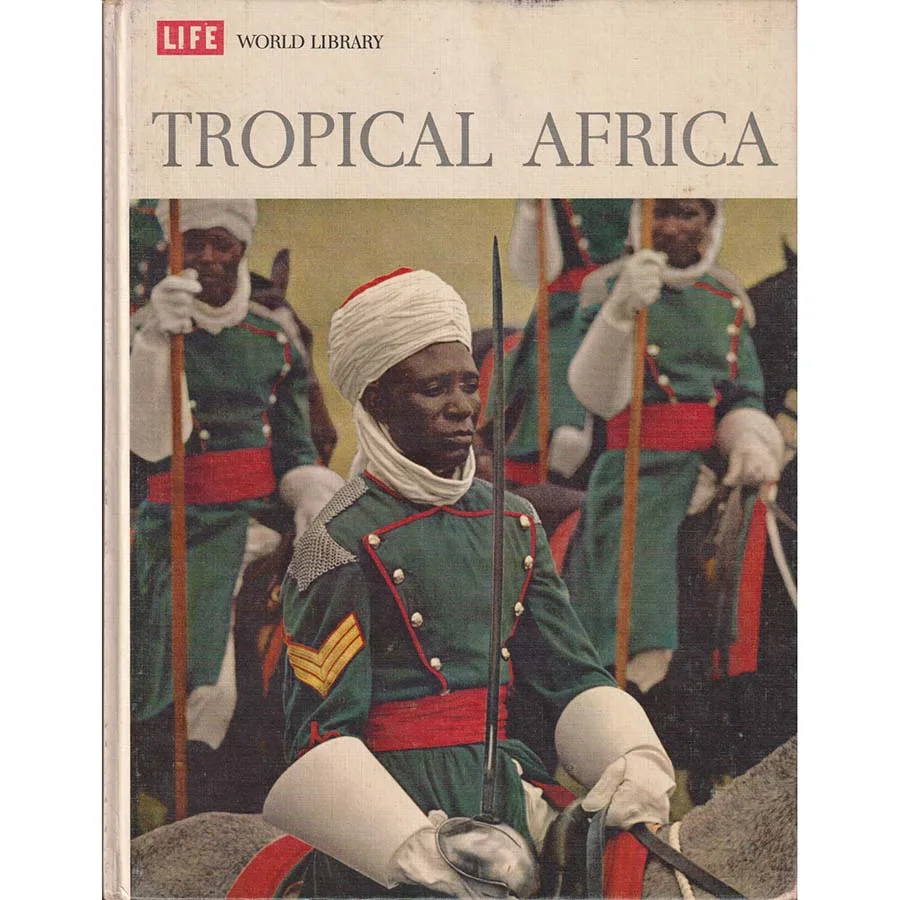
Publisher: Time-Life International
Format: Hardback
ISBN: none
Tropical Africa - Life World Library (1963) by Robert Coughlan – Time-Life International
ISBN: None
Condition: Good
Tropical Africa, 1963. An immense region of forests, savannahs, rivers, rapidly growing cities, ancient cultures, newly independent nations and enough political change to make any reference book publisher slightly nervous about the shelf life of its maps.
Published by Time-Life International as part of the ambitious Life World Library series, Robert Coughlan’s Tropical Africa is a substantial illustrated portrait of sub-Saharan Africa at one of the most extraordinary moments in the continent’s modern history.
And 1963 really was an extraordinary moment.
Across Africa, colonial rule was rapidly collapsing.
Ghana had become independent in 1957.
Nigeria followed in 1960.
Tanganyika in 1961.
Uganda in 1962.
Kenya would gain independence in the very year this book appeared.
Dozens of new countries were emerging within the space of only a few years, complete with new governments, new flags, new institutions and the rather formidable task of turning boundaries frequently drawn by European administrators into functioning modern states.
So this is not simply a geographical book.
It is a snapshot of a continent while the political map was still being rewritten.
Quite literally.
For the publishers, this must have been inconvenient.
You can imagine somebody at Time-Life finally approving a map only for a telegram to arrive announcing that another country had become independent and somebody needed to find the correction fluid.
The title itself—Tropical Africa—belongs very much to the style of mid-century publishing.
Today we are more accustomed to discussing individual countries, regions and societies separately, but books of this era cheerfully tackled vast areas of the world under broad geographical headings and then attempted to explain them in a single volume.
This is therefore Africa as viewed through the lens of early-1960s international publishing.
And that is precisely what makes it so interesting now.
The text and photographs show not only the continent but the way Western readers were being introduced to it more than sixty years ago.
There are cities, villages, farms, mines, rivers, markets, industries and landscapes stretching across a region whose sheer scale is difficult to appreciate from a European perspective.
Africa is enormous.
Properly enormous.
The sort of enormous that makes most European countries look as though somebody accidentally left them on the map after measuring something else.
The Sahara alone is larger than many countries people regard as quite substantial, and once you travel south of it the distances remain vast.
Rainforests.
Highlands.
Grasslands.
River systems.
Coastal regions.
Mountain ranges.
And enough ecological variety to make the phrase “African landscape” almost meaningless without further explanation.
Time-Life’s photographers naturally had a field day.
Wildlife provides some of the obvious visual drama.
Elephants.
Lions.
Giraffes.
Antelope.
Animals which modern television documentaries now present to us in astonishing detail were, for many readers in 1963, creatures encountered principally in books, zoos and the occasional cinema newsreel.
There was no high-definition wildlife channel.
No drone footage.
No live-streamed safari.
If you wanted to see a giraffe in its natural habitat without actually going to Africa, you opened a book.
Technology was brutal.
But somehow civilisation survived.
The really fascinating photographs today, however, may be the less spectacular ones.
An ordinary street.
A bus station.
A market.
A classroom.
A factory floor.
People going about their daily lives in clothes and surroundings that the photographer probably considered entirely contemporary.
Those images have since become historical records.
Cars disappear.
Buildings are replaced.
Roads are widened.
Cities expand.
Fashions change.
Shop signs vanish.
And suddenly the apparently mundane photograph on page 73 becomes far more interesting than the carefully composed landscape beside it.
That is the peculiar magic of old illustrated reference books.
They keep ageing after publication.
Eventually even the background becomes the subject.
The political content is particularly revealing.
In 1963, optimism surrounding African independence was widespread, but so were enormous challenges.
Many newly independent states inherited economies designed around colonial priorities, borders that often ignored ethnic or linguistic realities, limited infrastructure and administrative systems built primarily to serve imperial governments.
The future looked open.
Exciting.
Uncertain.
And in many places rather alarming.
Nobody reading this volume when it was new knew exactly how those new states would develop.
Some would enjoy periods of stability.
Others would experience coups, civil wars and dictatorship.
Some economies would grow rapidly.
Others would struggle.
Borders would remain surprisingly durable despite the circumstances in which many had been created.
And the continent’s population would increase enormously.
That lack of hindsight gives the book a particular atmosphere.
The future has not happened yet.
The author cannot quietly skip ahead and tell you which political experiment failed.
No one has added a helpful caption saying, “This situation becomes considerably more complicated in 1971.”
You are seeing the region as contemporary readers saw it.
That makes the optimism, assumptions and uncertainties much more revealing.
Robert Coughlan writes in the confident explanatory style associated with Time-Life publishing, when a respectable hardback was expected to provide its reader with a working understanding of a vast subject before dinner.
The editors have done the research.
The photographs have been selected.
The maps have been printed.
Africa will now be explained.
Please pay attention.
It is hard not to admire the confidence.
Modern readers are rather less trusting.
We can now spend four hours researching one tiny historical disagreement and emerge knowing less than when we started.
The 1963 approach was refreshingly straightforward.
Here is a continent.
Here are 160 pages.
We shall begin.
The book also inevitably reflects attitudes and terminology of its period.
That is worth remembering.
Ideas about race, development, colonialism and Western involvement in Africa have changed substantially since the early 1960s, and some language or assumptions may now feel distinctly dated.
But that does not make a historical book less useful.
Quite the opposite.
It makes the book evidence.
Old reference works allow us to see not only what people knew, but how they organised that knowledge and what they considered normal enough not to explain.
Sometimes the most interesting sentence in a sixty-year-old book is the one the author clearly thought was completely unremarkable.
The economic sections are similarly revealing.
Mining, agriculture, plantations, transport and resource extraction naturally feature prominently.
Copper.
Gold.
Diamonds.
Coffee.
Cocoa.
Rubber.
Timber.
Products that connected African economies to international markets long before most consumers gave much thought to where any of them came from.
There is also the enormous importance of rivers.
The Congo.
The Niger.
The Zambezi.
The Nile system further north and east.
These waterways were not merely features for geography examinations but transport routes, sources of food, barriers, political boundaries and central parts of regional life.
Hydroelectric projects were especially fashionable subjects for mid-century publishers.
Few things communicated “the future” in 1963 more effectively than a very large dam.
Preferably photographed from below.
With tiny people beside it.
Nothing says human progress quite like several million tons of concrete making a river reconsider its plans.
Cities were changing rapidly too.
Lagos.
Nairobi.
Kinshasa, then Léopoldville.
Accra.
Dar es Salaam.
Urban populations were expanding as people moved towards jobs, education and industry.
Many of those cities are vastly larger today.
A photograph that appears crowded by 1963 standards may now depict what looks almost like a quiet suburb.
The transformation has been enormous.
And that is perhaps the greatest appeal of the book today.
It captures a point before many of the changes that define modern Africa had fully unfolded.
Before today’s megacities.
Before mobile-phone networks transformed communication.
Before satellite television and internet access compressed distances.
Before many of the political conflicts now regarded as historical had even occurred.
It is Africa before the next sixty years happened.
Physically, the Life World Library series also belongs to that splendid era when knowledge was expected to weigh something.
These are proper books.
Substantial.
Illustrated.
Designed to occupy shelves.
A collection of them suggested that the owner possessed both a global outlook and adequately reinforced furniture.
Put Tropical Africa beside China, Canada, The Low Countries and South Africa and you begin to look like somebody preparing to brief the United Nations.
Whether you actually read them is between you and the bookshelf.
For collectors today, this volume offers a fascinating mixture of African history, decolonisation, geography, politics, social history, wildlife photography and mid-century publishing.
It would suit anyone interested in seeing how Africa was presented to an international readership during the great wave of independence in the early 1960s.
It would also suit anyone who enjoys old books precisely because they contain a world that has subsequently moved on.
Obviously, this is not a modern guide to tropical Africa.
Do not use it to plan border crossings.
Do not assume airlines still operate the routes described.
Do not rely on 1963 population figures.
And if somewhere is described as being reached by “a newly improved road”, further research might be advisable.
But as a historical document, it has aged magnificently.
The facts may have moved on.
The photographs cannot.
Condition: Good. A vintage copy showing the normal signs of age and previous ownership expected from a book published in 1963, but remaining in good overall condition and perfectly suitable for reading, collecting or displaying beside a globe while occasionally making thoughtful noises about decolonisation.
A fascinating period portrait of a huge and rapidly changing part of the world at precisely the moment when old empires were disappearing and dozens of new nations were taking their place.
Sold by Crappy Old Books, where the atlases may be out of date, the borders may have moved, and nobody has yet discovered a software update capable of fixing a 1963 map.
Keep browsing: See more Travel books Other books by Robert Coughlan
